by PAUL BYERLY | May 21, 2026 | Biases
Podcast: https://bit.ly/498tN36
Three more biases: the Zeigarnik Effect, Negativity Bias, and The False Consensus Effect. (Who names these things?)
The Zeigarnik Effect is our tendency to remember uncompleted tasks better than completed ones. So you recall the times your spouse didn’t finish something very clearly but tend to forget the times they completed a task. This skews your internal count.
Negativity Bias is the tendency to focus on negative experiences more than positive ones. To some degree, this is human nature. But some of us tend to be negative in general. In marriage this causes us to dwell on conflicts and problems rather than celebrating successes and good times together.

The False Consensus Effect is overestimating how much others share your opinions and beliefs. This can lead to assuming your spouse feels as you do about something and then being upset when you discover they do not.
This bias can also lead to mind reading, miscommunications, and frustration when spouses assume their partner shares their perspective, only to discover that they do not.
The bias can play out as assuming our friends agree with us about something we disagree with our spouse about. We think everyone agrees with us, making us less willing to attempt to understand what our spouse thinks.
There are plenty of other biases that can mess with how we see our spouse. The best way to avoid all of them is to keep asking yourself if you might have misunderstood or made a wrong assumption. Question what you think, then seek clarification from your spouse.
~ This is Paul, reminding you that Doing Marriage Well looks different for every couple. (And my wife does not agree with me on the ‘correct’ way to hang the toilet paper. ***note from Lori: because she is right about it***

All 14 turkey eggs hatched.

They are different sizes beause they hatched over about three weeks.
Image Credit: © Paul H Byerly created with Nano Banana 2
We’re donation supported Thanks for your help!
This post may contain affiliate links, see my disclosure for info.
by PAUL BYERLY | May 20, 2026 | Biases
Podcast: URL
Today our cognitive biases are the Availability Heuristic and Anchoring Bias.
Availability Heuristic is overestimating the importance of easily recalled information. This can be things which have happened a few times recently, or things given more weight than they should. For example, plane crashes are rare, but they get a lot of news time. Car accidents, which happen all the time, get far less attention from the media. So we might think flying is more dangerous than driving, or fail to understand how much safer flying is.
In marriage we’re better at recalling what we do than what our spouse does, so we give what we do too much weight. Or, if our spouse made a mistake once or twice recently, we see that rather than the many, many times they did it right before that. This one also tags our past; if a previous partner did something hurtful many times, that carries more weight than our new spouse doing it right every time but fewer times than our ex.
I have suggested in the past that a good way to track change is to mentally plot the high points. Doing that will help you overcome the availability heuristic.

Anchoring Bias is allowing an initial, strong impression to disproportionately influence current perceptions, ignoring more recent performance. The first time something happens anchors our understanding, belief, or expectation. This could be the first time we experienced something, or the first time we experienced it with a certain person, such as our spouse.
In marriage, this is one more block to seeing growth and change in your spouse. Or, we see the changes, but we fear they will return to what they did first, even if there is no evidence to support that. Or perhaps we want it done well as many times as it was done wrong before we accept the change is real. If we thought this through, we would realise it’s neither fair nor realistic. But the anchoring bias makes it feel right if we don’t work through it mentally.
Not seeing or acknowledging change leads to frustration. If your spouse works hard to improve, and you ignore it, they’ll wonder why they bothered. If they did it wrong for years, odds are they will not spend years doing it right without any change on your part.
Another way this plays out is unrealistic initial promises or expectations. If these become anchors, it can be difficult to come to a more reasonable agreement.
If you want to fight this bias, challenge your assumptions. When you think “He always does that” or “She never does such and such”, stop and ask if that is true. Was it once true, but is not now? Does it still happen, but not as often or as bad?
~ This is Paul, and acknowledging change is Doing Marriage Well.
Might rain

And it did!
Image Credit: © Paul H Byerly created with Nano Banana 2
We’re donation supported Thanks for your help!
This post may contain affiliate links, see my disclosure for info.
by PAUL BYERLY | May 19, 2026 | Biases
Podcast: https://bit.ly/3R9ef99
Today’s cognitive biases are Fundamental Attribution Error & Self-Serving Bias.
Fundamental Attribution Error is the tendency to attribute your own negative actions to external circumstances, while attributing your partner’s behaviour to their character.
So when you’re rude, it’s because you were stressed or rushed. When she’s rude, it’s because she’s selfish. If he leaves the dishes undone, it’s because he’s lazy. If you leave them undone, it’s because you had a horrible day or you’re getting sick. When you’re late, it’s due to unforeseen traffic. When your spouse is late, it’s because they are unreliable or refuse to keep track of time. When you don’t want to talk, it’s because you had a mentally exhausting day and need space. When they don’t want to talk, they are grumpy or don’t care about you.
In short, we give ourselves every possible benefit of the doubt, plus a few that are questionable. But we don’t cut our spouse much, if any, slack. We’re better than them, and they need to step up their game! The result is in anger and a sense of betrayal.
A way to challenge this is to try to find valid reasons. So, for example, the next time your spouse is late, try to invent three ‘external’ excuses for them (traffic, a last-minute phone call, a lost key) instead of a ‘character’ flaw.

Self-Serving Bias is a tendency to take credit for successes while blaming our spouse for failures. It can also manifest as minimising your mistakes while exaggerating those of your spouse.
When your marriage gets better, it’s because of the hard work you’ve put in. When your relationship suffers, it’s because of what your spouse has been doing wrong. You see the things you do around the house as more difficult or more important than the things your partner does. Arguments are always her fault, never your fault. When he hurts you, you’re a victim. When you hurt him, he needs to stop being so sensitive.
This bias can make your spouse feel unseen, unheard, or unfairly blamed. It undermines compassion and trust.
Both of the biases are based on retelling the facts to make ourselves better and our spouse worse. This is normal human behaviour we use to protect ourselves. But being normal doesn’t make it right. Nor does it keep it from hurting our spouse and our marriage.
Being able to accurately see ourselves and what we do is far more difficult than it should be. But it’s necessary for a healthy, growing marriage. One way to work on this is to ask a trusted friend to get in your business and tell you when they think you’re being unfair.
~ This is Paul, and seeing yourself honestly makes it so much easier to Do Marriage Well.
Lori is well loved.

And silly.
Image Credit: © Paul H Byerly created with Nano Banana 2
We’re donation supported Thanks for your help!
This post may contain affiliate links, see my disclosure for info.
by PAUL BYERLY | May 18, 2026 | Biases
Podcast: https://bit.ly/4u0hc9P
This week I want to talk about cognitive biases that can limit and hurt our marriages.
I don’t offer these so you can accuse your spouse of them. Seeing them in your spouse can help you navigate a situation better, but unless you’ve discussed biases and your spouse is open to you pointing them out, you’re probably better off not identifying them as they happen.
My primary reason for sharing these is so you can see them in yourself. These biases alter how we see reality, and that can lead to misunderstandings, hurt feelings, and arguments. As we go through the week, consider each bias, and ask yourself if you are given to it.

First we have Confirmation Bias. You interpret your spouse’s words or actions to fit your pre-existing belief. Your belief may be based on what they have done in the past or your own stuff. Either way, you see what you expect to see, rather than what is really there.
To see how this plays out in the living room or the kitchen, let’s look at a few common scenarios:
- The Underappreciated Spouse
A wife believes her husband doesn’t notice her efforts at home. When he walks past a clean kitchen without comment, she sees that as proof. When he thanks her for dinner, she dismisses it as automatic politeness. Her belief replaces reality as she plays up confirming evidence and downplays evidence to the contrary.
- The Criticism Loop
A husband believes his wife is hypercritical. He braces for criticism in every conversation, making him defensive. His defensiveness frustrates her, making her more critical. His original belief is self-fulfilling, but he is blind to his part.
- The Jealous Partner
A spouse suspects infidelity. A late meeting is proof. A normal meeting is suspicious. Friendliness toward an attractive person is a red flag. Coldness toward the same person is guilt. Fear colours every action, piling up more supposed proof of cheating.
- The Incompatible Couple
During a rough patch, one spouse decides they want such different things that they are incompatible. From then on, every disagreement is seen as proof of deep incompatibility, while areas of agreement are ignored.
Please challenge your negative beliefs about your spouse. Even if there was once truth there, people grow and change. Give your partner the benefit of the doubt, and look for change.
~ This is Paul, and Doing Marriage Well is easier when you see reality.
Snapped this at a friend’s house.

Image Credit: © Paul H Byerly created with Nano Banana 2
We’re donation supported Thanks for your help!
This post may contain affiliate links, see my disclosure for info.
by PAUL BYERLY | May 16, 2026 | Your Choice
Podcast: https://bit.ly/4dnoQ9b
I promised to talk today about living with it and ultimatums.
Deciding to live with a broken part of your marriage is sometimes the only sane choice. It can also be a very loving choice. But it’s not an easy thing, and you should devote a good deal of prayer and thought to it before you go that route.
If it’s become evident your spouse can’t or won’t change whatever, continuing to fight about it is putting both of you through turmoil for no reason. Letting it go is a kindness to yourself and your spouse.
There are two questions to ask yourself:
Does it justify divorce? If not, then living with it is pretty much your option. So how can you make the best of the situation? How do you get a life, invite your spouse to join you, and do life without them if they won’t join you? How do you grieve what your spouse is not doing, and then move past it? You need to let it go, rather than jabbing them about it from time to time or expecting to be thanked for your sacrifice.
If the issue does allow for divorce, then the question would be ‘Is that what God wants you to do?’ It being allowed does not make it God’s will. Can you live with it? Will it drive you crazy? Will you drive your spouse crazy?
If you still have children at home, living with it may be a temporary thing for their sake. This can be a painful sacrifice, and I have great respect for those who do that. May God give you strength.
An example: I think a spouse choosing to make the marriage sexless allows for divorce. But that does not mean a man or woman in that situation must or even should divorce. Can they live in a sexless marriage and continue to be loving? Can they deal with their sex drive and not end up in porn or the arms of another person? If you doubt you can avoid temptation, then divorce may be necessary.
I would suggest you can get help talking through these things, but ultimately you have to make the choice. And you have to live with that choice.
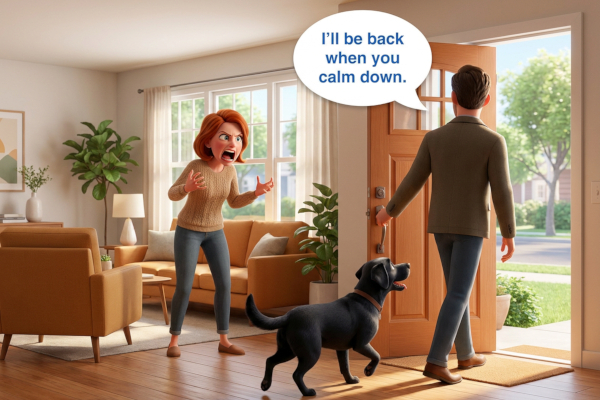
I find ‘ultimatum’ an ugly word because issuing one always causes pain and turmoil. But long-term, it can be a merciful option. I think an ultimatum should usually be given before filing for a divorce, with significant abuse being the exception. But there are other ways to use ultimatums; divorce is not the only consequence.
An ultimatum says, “I’m not playing your game any more. If you keep playing, here is what will happen.”
For an ultimatum to be effective, your spouse has to believe you will follow through if they don’t change. If you have made and not held to an ultimatum in the past, you don’t have that going for you. Involving a third party might help in this case.
An ultimatum should be simple and clear. First share what you expect, and how long you will wait. Then explain what will happen if what you expect does not occur. An ultimatum should be presented in writing so there is no doubt about what was said. You can give it verbally too, but written is a must. Writing will protect you from your spouse lying to others about what you said. It also forces you to be very careful, as your words can be used against you if you’re unfair.
I strongly advise you to talk with someone before making an ultimatum. In part to help you do it right, and also as a point of accountability. A leader at church would be a good choice.
Give a reasonable amount of time. And make “working on it” a reason to wait. But don’t let endless “I’m working on it” be used to get around the ultimatum. Be all about doing your part and hearing what your spouse thinks you need to do. But make it clear none of that changes what you have said.
As I said above, divorce is not the only possible consequence of an ultimatum. “I will move on with my life while continuing to live with you” is a possibility. Or you might say, “If you’re not ready on time, I will leave without you.” Or it could be “Dinner will be served at six; if you are not here, you are on your own.” Or, as in the image, “When you throw a fit, I will walk away.“
Of course doing these things is difficult. You will be met by anger and possibly threats. You will probably be treated worse than usual, and possibly lied about to friends. Expect this, and see it as part of the process. Change, if it happens, will come after the attempts to get you to back down fail. Stand firm; you are fighting for the health or survival of your marriage.
~ This is Paul, and sometimes Doing Marriage Well is painful.
We planted two dark-purple lilacs last fall. They survived deer and cold, and one is blooming.

In time these will help screen us from the road, and do it with great beauty!
Image Credit: © Paul H Byerly created with Nano Banana 2
We’re donation supported Thanks for your help!
This post may contain affiliate links, see my disclosure for info.
by PAUL BYERLY | May 15, 2026 | Your Choice
Podcast: https://bit.ly/492878I
So today we discuss choices and sex. There are so many ways to go with this. Everything I have said this week applies here. But I want to use sex to address another reason we make poor choices: not understanding the consequences of our choices. Or, downplaying the consequences in our minds. I’ll cover two issues today. The first is usually done by men, and the second is usually done by women. But both can go the other way. Regardless of who is doing them, the emotional fallout remains the same.
For the men the choice is easy: pornography.
For this discussion I’m talking about videos of fully naked women doing blatantly sexual things. I think porn is far more than that, but rather than argue where the line is, I have chosen something most will see as porn.
Most men would not look at porn if they knew the next time they did, their marriage would end. Many would manage to abstain from porn if they knew looking at it would end their sex life with their wife. But these are not the usual consequences of porn use, and the majority of churchgoing men look at porn at least once a month. (BTW, the same is true for at least a third of churchgoing women.)
Do these men think they get enough from porn to offset what it costs them? I suppose they do. But if they significantly misjudge what it costs them, then their conclusion is bad.
Here’s the thing, most women dislike their partner looking at porn, and about half see it as cheating. Those statistics are for the general population. Among Christians, far fewer women are in any way okay with it. If your wife sees porn as cheating, continuing to use it is killing her sexual desire for you. It’s also undermining her love for you. Arguing porn is not about her or is not cheating won’t change her mind or how she feels about it, nor will it change the consequences you suffer.
Guys, the next time you use porn, it probably won’t end your marriage or your sex life. But it will harm both of those, and it will hurt your wife. If you could really see the consequences of choosing to look at porn, I think you would find it far easier to stop.

For the women, let’s talk about empty sex.
Empty sex is what he gets when she “lies there and spreads her legs”. It’s saying yes with her body, but nothing more. It’s emotionally empty, and there is no effort to connect, engage, or make it good.
You might wonder why a man would accept empty sex. For the same reason a hungry person will eat food they don’t like. It’s not what they want, but it takes care of the hunger. If it’s all they can get and they’re really hungry, they go for it.
The problem is the long-term consequence. When your sexual desire is treated like changing a diaper, that hurts. And if that is how sex is, even for a minority of that time, it hurts deeply. It makes you feel unloved, and it undermines your love for the woman hurting you that way.
The reality is few men will keep accepting empty sex. It’s easier and less painful to just take care of it in the shower. Beyond that, it increases the temptation to lust and to act on said lust. This is not to excuse sin, but it is a potential consequence of empty sex.
The solution to empty sex is not faking something you don’t feel. The solution is seeing his desire as a valid part of the man you love and treating it as such. You don’t have to get fancy; an enthusiastic handjob can be far better than empty intercourse.
~ This is Paul, and the consequences of Doing Marriage Well are great!
It’s always something!

My portion of the mowing takes four or five hours a week. Plus weed eating.
Image Credit: © Paul H Byerly created with Nano Banana 2
We’re donation supported Thanks for your help!
This post may contain affiliate links, see my disclosure for info.


