by PAUL BYERLY | Jun 5, 2026 | Your Choice
Podcast: https://bit.ly/4vtL6Eg
Most of what I have said this week should apply to your sex life. But often, it doesn’t.
Sexual mismatch is one of the most common complaints couples have. But I want to go a different way with this today.
Let’s say Chris and Sam are married. Chris wants sex four times a week, and Sam wants it twice. That’s a problem. But there’s a good chance they are actually having sex only once a week. They are having less sex than either of them want! And odds are they are both making up the difference on their own.
Multiple studies have shown sexual frequency for married couples has dropped significantly and steadily over the last two decades. And younger couples are not having nearly as much sex as their parents had at the same age.

Experts offer theories for why this is, ranging from smartphone use to mental health to being too busy. But no one has proven why we have an epidemic of less sex. When we look at masturbation rates, we find it’s not a lack of drive. And one study found that the more often a married person masturbated, the less happy they were with their sex life, and the less satisfied they were with their marriage. So this is not an innocent trend; it’s a problem.
Do you assume the lack of sex in your marriage is because your spouse is happy with the amount you’re having? That could be true, but for a growing number of couples, both husband and wife want more sex. And most of those couples don’t know they both want more.
The first step is communication. Ask something such as, “Are you okay with how often we have sex, or would you like more?“
If you both want more, that means making time and energy for it. It also means not taking care of it yourself.
As a practical step, you could agree that from now on you will deal with your sex drives as a couple. That might mean lying side by side and masturbating. In the dark, if that’s what one of you needs. If only one of you feels the need, then you lie together as that person masturbates. Doing this is a start, and it helps you understand how often each of you would like sex. From there you can work on making it happen
~ This is Paul, and Doing Sex Well, requires doing it!

A storm broke off an iris stem, so we brought it inside.

It opened up nicely!
Image Credit: © Paul H Byerly created with Nano Banana 2
We’re donation supported Thanks for your help!
This post may contain affiliate links, see my disclosure for info.
by PAUL BYERLY | May 16, 2026 | Your Choice
Podcast: https://bit.ly/4dnoQ9b
I promised to talk today about living with it and ultimatums.
Deciding to live with a broken part of your marriage is sometimes the only sane choice. It can also be a very loving choice. But it’s not an easy thing, and you should devote a good deal of prayer and thought to it before you go that route.
If it’s become evident your spouse can’t or won’t change whatever, continuing to fight about it is putting both of you through turmoil for no reason. Letting it go is a kindness to yourself and your spouse.
There are two questions to ask yourself:
Does it justify divorce? If not, then living with it is pretty much your option. So how can you make the best of the situation? How do you get a life, invite your spouse to join you, and do life without them if they won’t join you? How do you grieve what your spouse is not doing, and then move past it? You need to let it go, rather than jabbing them about it from time to time or expecting to be thanked for your sacrifice.
If the issue does allow for divorce, then the question would be ‘Is that what God wants you to do?’ It being allowed does not make it God’s will. Can you live with it? Will it drive you crazy? Will you drive your spouse crazy?
If you still have children at home, living with it may be a temporary thing for their sake. This can be a painful sacrifice, and I have great respect for those who do that. May God give you strength.
An example: I think a spouse choosing to make the marriage sexless allows for divorce. But that does not mean a man or woman in that situation must or even should divorce. Can they live in a sexless marriage and continue to be loving? Can they deal with their sex drive and not end up in porn or the arms of another person? If you doubt you can avoid temptation, then divorce may be necessary.
I would suggest you can get help talking through these things, but ultimately you have to make the choice. And you have to live with that choice.
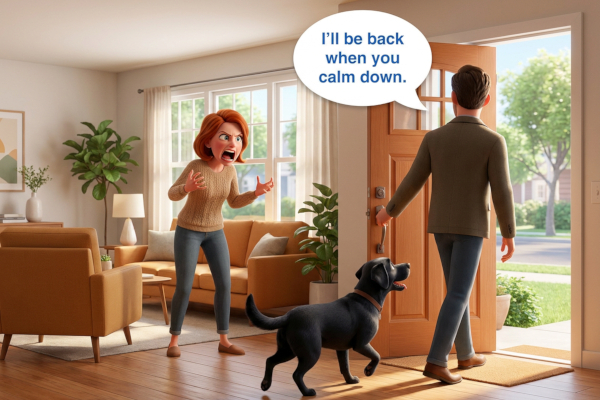
I find ‘ultimatum’ an ugly word because issuing one always causes pain and turmoil. But long-term, it can be a merciful option. I think an ultimatum should usually be given before filing for a divorce, with significant abuse being the exception. But there are other ways to use ultimatums; divorce is not the only consequence.
An ultimatum says, “I’m not playing your game any more. If you keep playing, here is what will happen.”
For an ultimatum to be effective, your spouse has to believe you will follow through if they don’t change. If you have made and not held to an ultimatum in the past, you don’t have that going for you. Involving a third party might help in this case.
An ultimatum should be simple and clear. First share what you expect, and how long you will wait. Then explain what will happen if what you expect does not occur. An ultimatum should be presented in writing so there is no doubt about what was said. You can give it verbally too, but written is a must. Writing will protect you from your spouse lying to others about what you said. It also forces you to be very careful, as your words can be used against you if you’re unfair.
I strongly advise you to talk with someone before making an ultimatum. In part to help you do it right, and also as a point of accountability. A leader at church would be a good choice.
Give a reasonable amount of time. And make “working on it” a reason to wait. But don’t let endless “I’m working on it” be used to get around the ultimatum. Be all about doing your part and hearing what your spouse thinks you need to do. But make it clear none of that changes what you have said.
As I said above, divorce is not the only possible consequence of an ultimatum. “I will move on with my life while continuing to live with you” is a possibility. Or you might say, “If you’re not ready on time, I will leave without you.” Or it could be “Dinner will be served at six; if you are not here, you are on your own.” Or, as in the image, “When you throw a fit, I will walk away.“
Of course doing these things is difficult. You will be met by anger and possibly threats. You will probably be treated worse than usual, and possibly lied about to friends. Expect this, and see it as part of the process. Change, if it happens, will come after the attempts to get you to back down fail. Stand firm; you are fighting for the health or survival of your marriage.
~ This is Paul, and sometimes Doing Marriage Well is painful.
We planted two dark-purple lilacs last fall. They survived deer and cold, and one is blooming.

In time these will help screen us from the road, and do it with great beauty!
Image Credit: © Paul H Byerly created with Nano Banana 2
We’re donation supported Thanks for your help!
This post may contain affiliate links, see my disclosure for info.
by PAUL BYERLY | May 15, 2026 | Your Choice
Podcast: https://bit.ly/492878I
So today we discuss choices and sex. There are so many ways to go with this. Everything I have said this week applies here. But I want to use sex to address another reason we make poor choices: not understanding the consequences of our choices. Or, downplaying the consequences in our minds. I’ll cover two issues today. The first is usually done by men, and the second is usually done by women. But both can go the other way. Regardless of who is doing them, the emotional fallout remains the same.
For the men the choice is easy: pornography.
For this discussion I’m talking about videos of fully naked women doing blatantly sexual things. I think porn is far more than that, but rather than argue where the line is, I have chosen something most will see as porn.
Most men would not look at porn if they knew the next time they did, their marriage would end. Many would manage to abstain from porn if they knew looking at it would end their sex life with their wife. But these are not the usual consequences of porn use, and the majority of churchgoing men look at porn at least once a month. (BTW, the same is true for at least a third of churchgoing women.)
Do these men think they get enough from porn to offset what it costs them? I suppose they do. But if they significantly misjudge what it costs them, then their conclusion is bad.
Here’s the thing, most women dislike their partner looking at porn, and about half see it as cheating. Those statistics are for the general population. Among Christians, far fewer women are in any way okay with it. If your wife sees porn as cheating, continuing to use it is killing her sexual desire for you. It’s also undermining her love for you. Arguing porn is not about her or is not cheating won’t change her mind or how she feels about it, nor will it change the consequences you suffer.
Guys, the next time you use porn, it probably won’t end your marriage or your sex life. But it will harm both of those, and it will hurt your wife. If you could really see the consequences of choosing to look at porn, I think you would find it far easier to stop.

For the women, let’s talk about empty sex.
Empty sex is what he gets when she “lies there and spreads her legs”. It’s saying yes with her body, but nothing more. It’s emotionally empty, and there is no effort to connect, engage, or make it good.
You might wonder why a man would accept empty sex. For the same reason a hungry person will eat food they don’t like. It’s not what they want, but it takes care of the hunger. If it’s all they can get and they’re really hungry, they go for it.
The problem is the long-term consequence. When your sexual desire is treated like changing a diaper, that hurts. And if that is how sex is, even for a minority of that time, it hurts deeply. It makes you feel unloved, and it undermines your love for the woman hurting you that way.
The reality is few men will keep accepting empty sex. It’s easier and less painful to just take care of it in the shower. Beyond that, it increases the temptation to lust and to act on said lust. This is not to excuse sin, but it is a potential consequence of empty sex.
The solution to empty sex is not faking something you don’t feel. The solution is seeing his desire as a valid part of the man you love and treating it as such. You don’t have to get fancy; an enthusiastic handjob can be far better than empty intercourse.
~ This is Paul, and the consequences of Doing Marriage Well are great!
It’s always something!

My portion of the mowing takes four or five hours a week. Plus weed eating.
Image Credit: © Paul H Byerly created with Nano Banana 2
We’re donation supported Thanks for your help!
This post may contain affiliate links, see my disclosure for info.
by PAUL BYERLY | May 14, 2026 | Your Choice
Podcast: https://bit.ly/4diYBPH
Another reason we fail to make the right choices in our marriage is fear. This is an issue, especially with regard to making changes or pushing our spouse for change.
Fear of failure is one version of this. Doing nothing seems safer than trying and finding that you can’t, or your spouse won’t. As long as you don’t make the effort, you don’t have to face the possibility it can’t be fixed. This can lead to a kick-the-can-down-the-road attitude that allows a problem to grow. This makes it harder to resolve the problem when you finally feel you must. It’s also possible the problem will grow too big for you, or your spouse will get tired of it and withdraw emotionally or seek a divorce.
If you realise you’ve been doing this, please get help. If a friend’s encouragement is not enough, get some other form of third-party help.
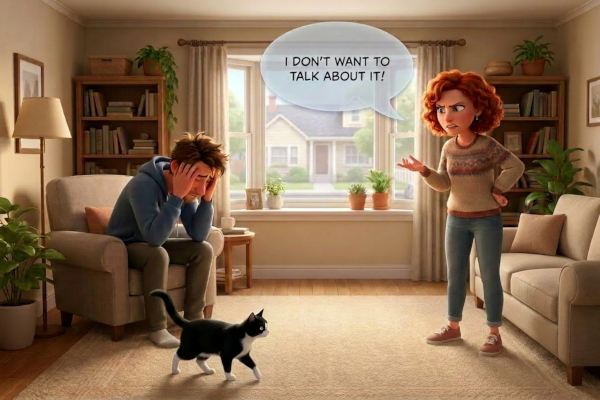
The fear of change can be a powerful fear. This fear keeps us doing things we know don’t work. It can also cause us to fight our spouse making good, needed changes. We may cling to negative situations because they are predictable and take a familiar misery over a foreign hope. Part of this is about a desire to be in control. Change is new and unpredictable, and we don’t know how or if we can control something new.
While some fears are internal, others are driven by the reaction of our spouse. This is most evident when anger becomes a weapon. The fear of their spouse getting angry keeps people from confronting something that is very wrong and needs to change. The spouse in the wrong is using anger to avoid the conversation, and it’s very much intentional. It might not have started that way, but when they learned their anger meant they could keep the issue at bay, it became their go-to tactic. Doing that is not just wrong, it’s abusive.
Once fear of anger has taken hold, it’s difficult to move forward. If you try to push past the anger, your spouse will probably escalate their anger to keep you in control. You will most likely need help to make progress. At the very least, you will need encouragement to get past your fear and confront your spouse. Getting your spouse to a third party is the best option, but they will likely refuse. That leaves you with two choices: live with it or give an ultimatum. I’ll cover these options on Saturday.
~ This is Paul, and fear derails Doing Marriage Well.
The new strawberry beds are looking good.

Lost a few over the winter, but they throw off new ones like crazy, so we can fill in.
Image Credit: © Paul H Byerly created with Nano Banana 2
We’re donation supported Thanks for your help!
This post may contain affiliate links, see my disclosure for info.
by PAUL BYERLY | May 13, 2026 | Your Choice
Podcast: https://bit.ly/4eI5k8n
One reason we make poor choices in marriage could be called ‘laziness’. What we should do would take time and effort we’re not willing to spend. Change is hard, so we settle for living with what is.
If you make bad marriage choices because of personal comfort, or just not being willing to expend the energy, that’s clearly a you problem that you need to deal with. Left unchecked, this will kill your marriage.
But I want to take a deeper look at this. If your spouse is being lazy in how they treat you, then it’s not just about you. If you recognise this is happening, you can choose to do what is right, as I suggested on Monday. You can also choose to talk to your spouse about where they are falling short.

But what if it’s not laziness? Psychologists say perceived laziness can be a symptom of things such as burnout, low motivation, or detachment.
- Burnout is a growing issue in our too-busy, too-stressed world. Burnout kills our ability to do things. It’s not that we’re too lazy to act; we just don’t feel able to. Burnout external to the marriage can do this, or it can be marriage burnout specifically.
- Low motivation can be a lifelong thing, probably based on our childhood. It can also be situational. If your marriage does little for you, it’s difficult to be motivated to spend the energy to change it. This is especially true if you’ve tried and failed or are convinced your spouse is unwilling to change.
- Detachment can keep you from being aware of needs or problems. It may look like you don’t care, but you can’t care when you don’t have a clue. Additionally, detachment can cause or worsen low motivation. Detachment can be about your marriage, or it could be from the past.
If you think your spouse is being lazy, perhaps it’s something else. Burnout, low motivation, and detachment should be dealt with differently than laziness. If you accuse them of laziness when it’s not that, you just alienate them.
The same considerations apply when you feel you’re being lazy. Is it really that, or is that an easy excuse to avoid admitting something more difficult?
~ This is Paul, reminding you that Doing Marriage Well looks different for every couple.
Eleven ducklings have been hatched and are now being brought to our pond to learn to swim and eat.

Widget is not happy about sharing the pond, and mama duck is not happy about a dog that loves to swim.
Image Credit: © Paul H Byerly created with Nano Banana 2
We’re donation supported Thanks for your help!
This post may contain affiliate links, see my disclosure for info.
by PAUL BYERLY | May 12, 2026 | Your Choice
Podcast: https://bit.ly/4d6u0Gg
A great many things influence our choices, and often we are not aware of some, or many, of those.
One factor is cognitive dissonance:
Cognitive dissonance is the mental discomfort experienced when holding two or more contradictory beliefs, values, or attitudes, or when behaviour conflicts with beliefs.
No one likes ‘mental discomfort’, and we will do a great deal to avoid it. In marriage this can lead to justifying unhealthy behaviours in our spouse. It can cause us to lower standards to match those of our spouse. Or we may try to change what we think and feel to match them. We do all of this in the name of avoiding conflict.
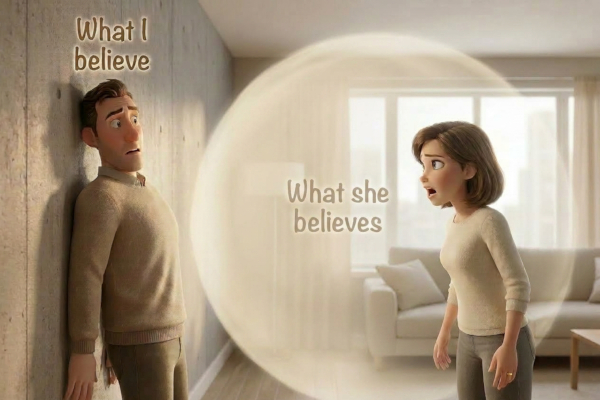
More than once I have watched one spouse change their religious beliefs to match changes in their spouse. I’ve seen changes in how one spouse says the children should be raised to avoid conflict. I’ve seen changes to line up politically. And I’ve seen one spouse try to enter into sexual experiences they don’t want, enjoy, or see as moral to try to keep their spouse happy.
I understand how uncomfortable it is to be at odds with your spouse on significant issues. Sacrificing your beliefs, or pretending they don’t matter, may seem like a good way to prevent that. But it brings a false, temporary peace. If your spouse continues to change away from what you believe, how far are you willing to go?
Besides, our beliefs are a fundamental part of us. Sacrificing them is violating who God made us to be. And that tears us up.
One extreme example of this is a husband or wife who enters into wife swapping, swinging, or an open marriage because their spouse wants it. The fear is if they don’t go along, their spouse will either have an affair or leave them. That might be what would happen, but violating yourself to prevent that is neither right nor healthy.
Another example is going to a church that teaches things you feel are contrary to the Bible. Not a few minor things, but big issues. It eats at you, but going to the same church seems more important. There are also various ways this happens with regard to child-raising. I’m all for a unified message to our kids, but
not at the cost of what we feel is right.
Once you start down any of these paths, it’s very difficult to turn back. You have a better chance of fighting whatever when it’s just a suggestion than once you have gone there.
Standing firm against your spouse is not a comfortable place to be. But giving in is wrong and ultimately does more harm. Choose to stand firm and pray hard. Be open to the possibility you’re wrong, but don’t give in just for peace.
~ This is Paul, and sometimes Doing Marriage Well means standing firm.
Got some potatoes planted today and have the watering system working.

Cheese, one of our roosters, kept an eye on me. Mac, our other rooster, is less worried about what I do.
Image Credit: © Paul H Byerly created with Nano Banana 2
We’re donation supported Thanks for your help!
This post may contain affiliate links, see my disclosure for info.


